Stephen Rayment
Founder, CEO & Group Managing Director
Founder, CEO & Group Managing Director
Private equity is circling the legal sector with real intent, in the US, the UK, and offshore. Billion-dollar funds, in-house investment vehicles at major firms, and a wave of Alternative Business Structure (ABS) deals are reshaping who actually holds the equity behind legal advice.
The question worth asking before signing an engagement letter: whose interests sit behind the firm advising you?
Portfolio breadth. A PE house with dozens or hundreds of portfolio companies inevitably ends up connected to both sides of disputes, financings, or regulatory matters a firm handles. Conflicts checks get harder to run cleanly the wider an investor’s book becomes.
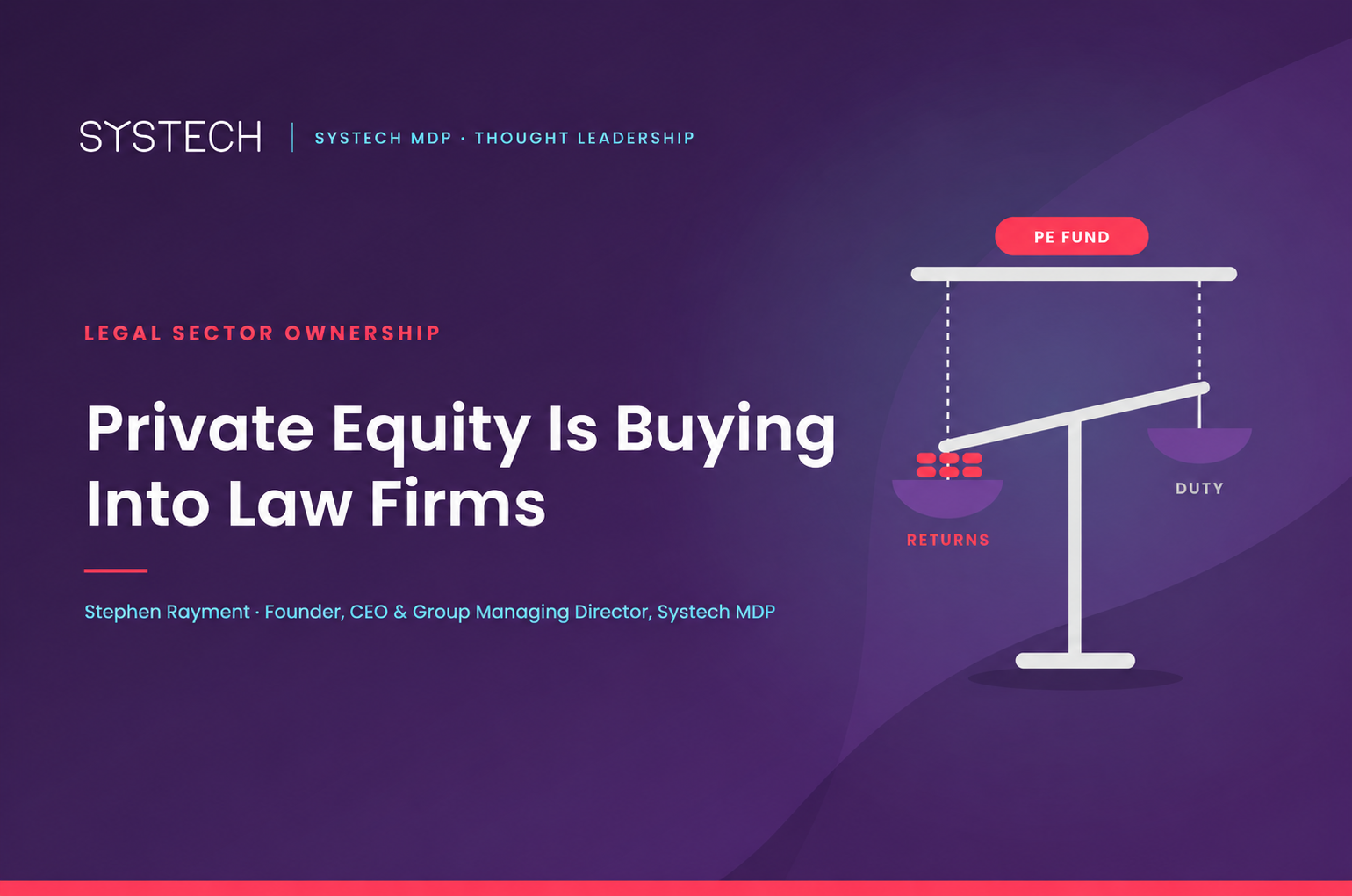
Independence of judgement. Professional conduct rules, Rule 5.4 in the US and the Solicitors Regulation Authority’s (SRA) framework in the UK, exist precisely to stop outside capital from pressuring lawyers toward returns over duty: settling early, cutting corners, or steering advice to protect an investor’s other holdings.
Structuring around the rules, not through them. In US states that still restrict non-lawyer ownership, PE is entering via Management Services Organisation (MSO) structures: investors own the marketing, technology and back-office layer while lawyers retain the professional entity. Even regulators who have approved this cautiously, Texas being one example, have flagged that it does not fully insulate against investor influence.
In-house investment funds. A number of the largest US firms quietly run internal investment vehicles that let partners invest alongside their own private equity clients. None will discuss it publicly, and the debate over whether that is alignment or an unresolvable conflict is very much live.
The UK’s stricter line. One instructive example: a partner at a major firm’s London office was refused permission to invest in his own firm’s fund, because the SRA’s conflict rules did not allow it. A US firm operating in the same city might well have reached a different answer. Regulatory culture, not just the rulebook, matters.
THE QUESTION:
Whose interests sit behind the firm advising you?
Systech International sits on the other side of this picture entirely. Our legal capability trades as a licensed ABS, regulated by the SRA, integrated into a wider multi-disciplinary practice (MDP) alongside our commercial and technical consultancy. But the ownership structure is the point: Systech is privately owned and privately financed. There is no external private equity fund, no portfolio of competing or adjacent interests, and no return-driven investor sitting between our advisers and our clients.
That matters in construction and engineering disputes specifically. Our clients need advisers whose only economic interest is the quality and independence of the advice itself, not a fund’s exit timeline, a co-investment with the other side, or pressure to settle a claim to protect a portfolio position elsewhere.
PE capital is not inherently incompatible with good legal advice. Plenty of the structuring work being done on MSOs and ABS licensing is careful, deliberate, and well-supervised. But it does introduce a layer of interests that clients are entitled to ask about. Before instructing any multi-disciplinary or PE-backed provider, it is worth asking a simple question: who owns the firm, and what do they want out of it?
Before instructing any multi-disciplinary or PE-backed provider, ask who owns the firm, and what they want out of it. I’d be interested in how others are approaching this.
Systech International: legal, commercial and technical expertise, independently owned. This article is general commentary on ownership structures in the legal sector, not legal advice; regulatory positions differ by jurisdiction and are evolving, and any specific engagement turns on its own facts and the applicable professional rules.