
Stephen Rayment
Founder, CEO & Group Managing Director
Founder, CEO & Group Managing Director
Begin with the party the system most often fails. A specialist subcontractor, a piling contractor, a cladding installer, a mechanical and electrical trade, finds itself in dispute with a main contractor or employer many times its size. The claim is meritorious: an extension of time is plainly due, and with it the prolongation cost that is keeping the business awake at night.
But to vindicate it through conventional means the subcontractor must instruct a firm of solicitors, then separate counsel, then a separate delay expert and very possibly a separate quantum expert, each retained on its own terms, each charging to absorb the same documents and learn the same project from scratch. The fees mount before a single pleading is served. For a well-capitalised opponent that is an inconvenience. For the subcontractor it is frequently the moment the claim is abandoned, not because it is wrong, but because justice has been priced out of reach.
That asymmetry is the problem to keep in view. It is the reason proportionality is not a soft, second-order nicety in dispute resolution but a structural question about who gets to be heard at all. And it is the strongest argument for the modern, integrated, multi-disciplinary practice, provided, and the proviso matters, that the safeguards on independence are real.
It is tempting to treat the barristers’ chambers model, self-employed practitioners sharing premises and clerks but not profits, as the natural order of things, and every departure from it as a deviation to be justified. That has the history backwards. The integrated firm is not an aberration the law tolerates; it is a structure the law deliberately created. The Legal Services Act 2007, enacted after Sir David Clementi’s review and a White Paper pointedly entitled Putting Consumers First, set out the regulatory objectives that now govern legal services in England and Wales, and among them, in black letter, are improving access to justice and promoting competition.
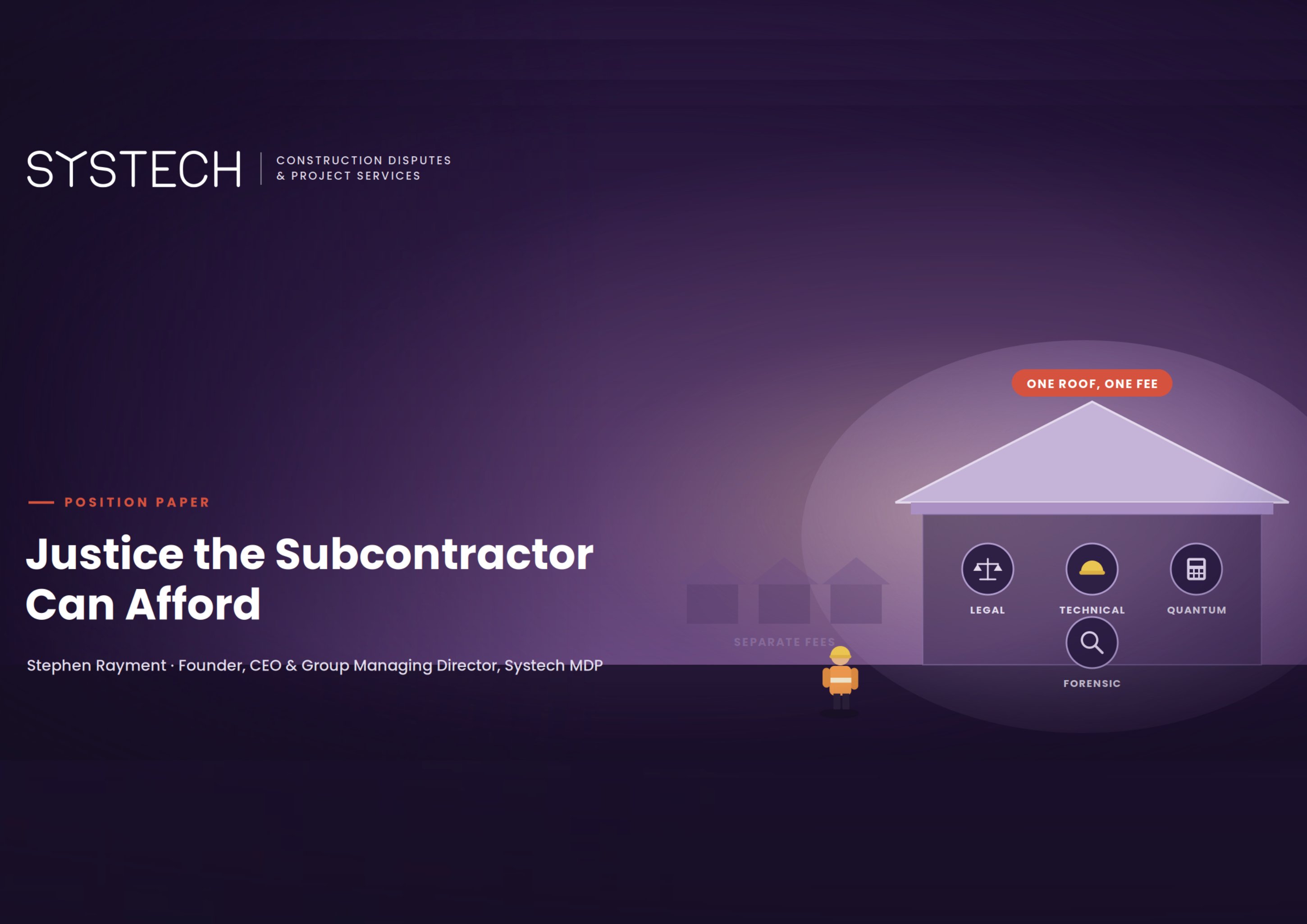
1To deliver those objectives Parliament authorised the alternative business structure: a body that may combine lawyer and non-lawyer ownership and deliver legal services alongside other professional disciplines.2 The ambition was explicitly the “one-stop shop”: better, cheaper, more accessible services through integration rather than fragmentation. Access to justice was so central to the design that ABS licensing was originally tied to it directly. So when a multi-disciplinary practice brings the legal, technical, financial and forensic skills a construction dispute actually needs under one roof, it is not stretching the rules. It is doing precisely what the modernising legislation envisaged. The honest question is never which structure is older; it is which structure delivers a reliable result, at a proportionate cost, with the safeguards in place. On that test the label on the door counts for far less than the architecture behind it.
The savings are not rhetorical; they are mechanical, and they compound. One retainer replaces three or four. A single team already holds the project documents, the programme, the delay narrative and the cost model, so there is no duplicated ingestion of the same lever-arch files by separate firms each billing to come up to speed. The legal analysis and the technical analysis are built together rather than couriered between offices, which removes the most expensive friction in any construction reference: the repeated, chargeable translation between lawyers who do not read critical-path analyses and experts who do not read contracts. Accountability sits in one place. Decisions are faster because the people making them share a corridor rather than a calendar. Those efficiencies fall most heavily in favour of the party least able to absorb waste.
This is the point the purists tend to pass over. Proportionality is not a luxury afforded to the system once independence has been perfected; it is one of arbitration’s founding promises. The Arbitration Act 1996 states in its opening section that the object of arbitration is the fair resolution of disputes without unnecessary delay or expense, and imposes on the tribunal a duty to adopt procedures that avoid exactly that.3 A structure that lets a budget-constrained party put its case properly is not in tension with that promise; it is the promise being kept. It should be permitted on that ground unless a real, demonstrated risk to independence outweighs it.
Construction already chose proportionality over perfect process
If anyone doubts that the construction sector is willing to trade procedural purity for accessible, affordable justice, it has already done so, by statute, and emphatically. Following Sir Michael Latham’s 1994 report Constructing the Team, Parliament gave every party to a construction contract the right to refer a dispute to adjudication: a 28-day, interim-binding, “pay now, argue later” process designed above all to protect cash flow down the payment chain, which is to say, to protect subcontractors.4 Adjudication is avowedly rough-and-ready. It accepts a faster, cheaper, less-than-perfect answer because the alternative, pricing modest parties out of any remedy at all, was judged the greater injustice. That is the sector’s settled value judgement, and it is squarely on the side of the integrated model. To accept adjudication’s proportionality bargain in the same breath as rejecting a multi-disciplinary practice for being insufficiently traditional is not principle; it is inconsistency wearing the costume of rigour.
None of this works if the safeguards are hand-waved, so let us state the objection at its strongest rather than its weakest. The serious concern about an MDP is not that an expert and the advocates share a building or a brand; it is that, where they share profits, the expert acquires a financial stake in the client winning, which cuts across the expert’s overriding duty to the tribunal to be objective. That is a real point, and it is why the glib defence, that you tolerate barristers from the same chambers so you must tolerate us, is the wrong argument to lead with: the tolerance extended to chambers rests precisely on the fact that barristers do not share profits.
The modern firm should not borrow an indulgence whose whole rationale is the absence of the feature the firm contains. The better case stands on safeguards that can be built and shown. English law already establishes the key foundation: an employed expert is not disqualified merely by the relationship. In Field v Leeds City Council the Court of Appeal held that employment by a party does not in principle prevent a person giving independent expert evidence, provided they are properly qualified and understand the overriding duty to the court; the connection goes to the weight of the evidence, not its admissibility.
5 If a directly employed expert can be independent, so can an expert in an integrated firm, if the firm builds independence in rather than asserting it. What does “built in” mean in practice? Experts who do not participate in the firm’s profits, removing the crudest incentive. Genuine information barriers and separate management lines, not cosmetic ones: the lesson of Secretariat v A Company, where the Court of Appeal treated entities that marketed themselves as one global firm and shared a common financial interest as one for conflicts purposes, is that separation must be real or it counts for nothing.
6 No cross-referral incentives that quietly reward a helpful opinion. And, above all, candid disclosure to the tribunal of the expert’s relationship not only with the party but with its lawyers, exactly as the IBA Rules on the Taking of Evidence require.7 Where the stakes or the optics demand it, a genuinely external expert remains available as the cleanest answer. Disclosure, not concealment, is the discipline that makes the model defensible.
The right response from tribunals and opposing parties is therefore not a reflexive veto on any expert who shares a firm with the lawyers. It is the same proportionate, facts-based approach English law already applies to employed experts: require full disclosure, let the connection go to weight, allow searching cross-examination on independence, and reserve exclusion for cases of real, demonstrated risk rather than mere structural unease. A blanket rule that an integrated firm may never provide both legal representation and expert evidence would not protect the process; it would simply reintroduce, through the back door, the very cost barrier that defeats the under-resourced claimant, and it would do so in the name of a formalism that the law of employed experts, the policy of the Legal Services Act, and the construction sector’s own embrace of adjudication all reject.
Move with the times, then, but carry the safeguards with you. The case for the modern multi-disciplinary practice does not rest on analogy to chambers, and it does not ask to be excused. It rests on two propositions that are difficult to gainsay: that an integrated structure can deliver a competent, accountable result at a cost the smaller party can actually bear; and that independence can be engineered, disclosed and tested rather than merely assumed.
Set those alongside the access-to-justice purpose Parliament wrote into the statute, and the sector’s own proven willingness to prize proportionate justice over perfect process, and the burden shifts. It is no longer for the modern firm to prove it deserves a place at the table. It is for the traditionalist to explain why a meritorious subcontractor should be shut out of justice to preserve an organisational form whose only real claim is that it came first.
Notes
1. Legal Services Act 2007, s 1(1), the regulatory objectives, including (c) improving access to justice and (e) promoting competition in the provision of services. The Act followed Sir David Clementi’s Review of the Regulatory Framework for Legal Services in England and Wales (2004) and the Government White Paper The Future of Legal Services: Putting Consumers First (2005).
2. Legal Services Act 2007, Part 5, licensing of alternative business structures (ABSs), permitting combined lawyer and non-lawyer ownership and management and the delivery of legal services alongside other services, regulated in England and Wales by the SRA (and other licensing authorities) from 2011. The Act originally required ABS licensing rules to address how an applicant would improve access to justice (s 83(5)(b)), a provision later the subject of deregulatory proposals.
3. Arbitration Act 1996, s 1(a) (the object of arbitration is the fair resolution of disputes by an impartial tribunal without unnecessary delay or expense) and s 33(1)(b) (the tribunal’s duty to adopt procedures avoiding unnecessary delay or expense and providing a fair means of resolution). Proportionality is also central to the court’s overriding objective (CPR r 1.1) and to costs assessment (CPR r 44.3(5)).
4. Housing Grants, Construction and Regeneration Act 1996, Part II, conferring a statutory right to refer construction disputes to adjudication (a 28-day, interim-binding, ‘pay now, argue later’ process), enacted following Sir Michael Latham, Constructing the Team (HMSO, 1994); the regime was designed in significant part to protect cash flow for parties down the payment chain, including subcontractors.
5. Field v Leeds City Council [1999] EWCA Civ 3013 (CA), per Lord Woolf MR: employment by a party does not in principle disqualify a person from giving expert evidence, provided they are properly qualified and understand the overriding duty to the court; any connection goes to the weight of the evidence rather than its admissibility.
6. Secretariat Consulting Pte Ltd v A Company [2021] EWCA Civ 6 (a construction delay-and-quantum dispute): an expert-services group that markets itself as one global firm and shares a common financial interest may be treated as one for conflicts purposes, so internal separation must be real rather than cosmetic.
7. IBA Rules on the Taking of Evidence in International Arbitration (2020), Article 5, requiring a party-appointed expert to state their independence and disclose any relationship with the parties, their legal advisers and the tribunal; see also the CIArb Protocol for the Use of Party-Appointed Expert Witnesses in International Arbitration.
Note on this paper: this is an advocacy document. It argues one side of a genuinely contested question and should be read as such. The opposing case, that shared profits compromise expert independence in a way disclosure cannot fully cure, is real and is engaged, not dismissed, in the section on safeguards. The legal references are accurate and citable; the proportionality and access-to-justice arguments are framed as policy and principle rather than as guarantees of any particular tribunal’s ruling on a live conflict, which will always turn on its own facts and the applicable rules. This is not legal advice.

Why take the difficult road of a Force Majeure claim when it is possible to take the easier path of a conventional claim?

The construction industry is credit-heavy and complex, a very dangerous combination that often leads to contractors not getting paid on time and/or not receiving ...

The application of sampling has not always been well received by courts and tribunals, primarily because, by its nature, it alters the burden of proof.

Standard form contracts usually stipulate a period within which the contracted works must be completed by the contractor.