Stephen Rayment
Founder, CEO & Group Managing Director
Founder, CEO & Group Managing Director
Texas is building faster than anywhere on Earth. For contractors and subcontractors, a single dispute on a project this size can be a last stand - here's how to avoid making one.
Texas now has 26 gigawatts of existing and under-construction data centre capacity, double Virginia's 13GW, according to Jones Lang LaSalle data reported in August 2026 - and is projected to exceed 40GW by 2028.
At least 335 data centres are already operating in the state, according to the Houston Chronicle's data centre tracker, with another 225 planned (other trackers using different methodologies show different totals, but all point the same direction: rapid, large-scale growth). ERCOT told Texas lawmakers in July 2026 that it was reviewing more than 474 gigawatts of grid connection requests, roughly 90% of them from data centre projects.
Put in global context, the entire world is expected to add approximately 100GW of data centre capacity by 2030. Texas recorded approximately $9.9 billion in data-centre construction starts through July 2026, according to ConstructConnect. That sits inside a global data centre market worth $425–540 billion a year and a $3–7 trillion global capital supercycle to 2030 - Texas alone is now a material slice of an entire planet's AI infrastructure investment.
Individual projects are now larger than entire industries used to be. The Stargate campus near Abilene - the first site in OpenAI, Oracle and SoftBank's wider $500 billion national Stargate programme - has already drawn approximately $15 billion in committed capital for this one location, according to Wall Street Journal reporting. The proposed HyperGrid campus near Amarillo is pitched at up to $300 billion.
This is genuinely good news for the state's construction industry. It's also, quietly, one of the biggest emerging sources of contractor and subcontractor risk in the market today.
Fast-track infrastructure delivery, compressed schedules, and liquidated damages tied to milestones like energisation and rack-readiness are a proven recipe for disputes - and data centres are being built faster and bigger than almost anything that's come before them.
We're already seeing it. Long-term capacity commitments in this sector now run to eye-watering scale: one recently reported 15-year, take-or-pay lease between a data centre operator and a hyperscale tenant was valued at approximately $9.8 billion over its base term - the kind of contract value that turns a routine performance dispute into a company-defining one.
Closer to home, Texas is also seeing a second dispute front open up: county-level moratoriums and zoning fights. In Hill County, a developer that said it had spent nearly $1 million pursuing and carrying out due diligence on a proposed 1,235MW project, while holding contracts to purchase more than 800 acres for over $80 million, found itself in court after the county imposed a construction moratorium. The county later rescinded the moratorium, and the developer dismissed the lawsuit in July 2026. Hood County is in ongoing, now-appealed litigation over the scope of county planning authority. These disputes aren't about delay or defects - they're about whether the project gets built at all.
A single dispute on a project of this scale can be existential for a contractor or subcontractor in a way it never was on a conventional commercial building.
Liquidated damages on a gigawatt-scale facility are not proportionate to a mid-size contractor's balance sheet. A few weeks' slippage on an energisation milestone can create substantial liquidated-damages exposure - on a project where the contractor's own margin might be a fraction of that.
Multi-party, multi-contract structures mean subcontractors can find themselves pulled into disputes far larger than their own scope of work, with joint claims, consolidation clauses, and flow-down liability provisions written into contracts they may not have had much leverage to negotiate.
And the resourcing crunch is real: with well over 100 data-centre and technology-infrastructure projects reported to be in active construction in Texas alone, the specialist project controls, commissioning and management talent needed to hit these schedules is stretched thin. Delay increasingly isn't caused by bad design or bad faith - it's caused by simply not being able to find the people to do the work fast enough. That's not a defence that protects you from an LD clause.
The instinct is often to reach for the dispute resolution clause when things go wrong. But by the time you're in arbitration or litigation - 18 to 36 months, easily - the damage to cash flow and the commercial relationship is often already done.
Disciplined, continuous project controls that create a contemporaneous, defensible record of schedule and cost from day one.
Early identification of resourcing gaps before they become delay.
Contract review that catches poorly calibrated liquidated damages and change-in-law clauses before signature, not after a claim.
Where a dispute does arise mid-project, supplemental agreements that tie settlement terms to verified, ongoing delivery, rather than letting the project stall while lawyers argue over liability.
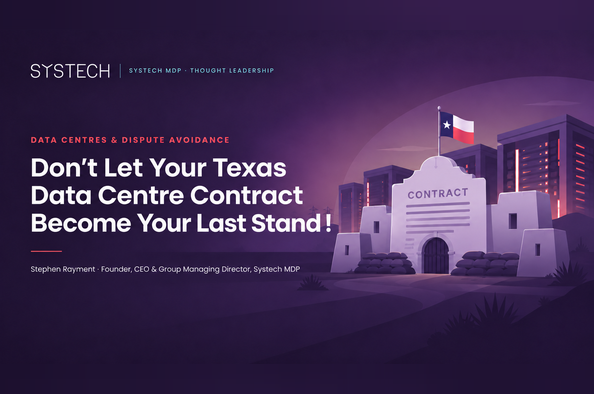
Texas’s data centre boom is real, and the pipeline remains enormous. The contractors and subcontractors who come out of this cycle intact will be the ones who treated dispute prevention as a project discipline from day one - not the ones who found out too late that their contract had become their Alamo: a last stand they never chose, on ground they didn't get to pick.
A NOTE ON SCOPE
This article draws on Systech International's ongoing work advising on dispute avoidance and resolution for data centre and infrastructure projects, including in Texas. Systech provides Foreign Legal Consultants (FLCs) and technical experts - in project controls, quantum, delay and international consultancy - not Texas-licensed lawyers. Systech is not licensed to practise or advise on Texas law; where advice or representation under Texas law is required, Systech works alongside appropriately licensed Texas co-counsel.